
In Germany, not everyone is required to file a tax return. However, doing so voluntarily can be worthwhile in some cases. If you are not required to file an income tax return, you have much more time to do so. As tax advisors in Düsseldorf
and Oberhausen
, we often find that clients are very surprised when we mention that a voluntary tax return can be filed retroactively for a long period of time. To address some of the most common questions on this topic, we’ve summarized everything you need to know. So how does filing a tax return retroactively work? And what should you keep in mind?
When is it permissible to file a tax return retroactively?
A tax return can only be filed retroactively if there is no obligation to file it. For taxpayers who are required to file their return by the deadline, it is of course not possible to do so retroactively. If the filing deadline is missed, additional late filing penalties may even be assessed. The situation is different if you are not required to file a tax return. Especially as an employee, there is often no obligation to file a tax return. Filing is therefore voluntary. Anyone who wishes to voluntarily file an income tax return may do so retroactively. In this context, “retroactively” means that more time is allowed. To file a tax return retroactively, no return for the respective year may have been filed yet. If these two conditions are met, the taxpayer has plenty of time to file the tax return and can also claim it retroactively.
How long can you file a tax return retroactively?
Anyone required to file a tax return must do so in the following year. A voluntary tax return, however, can be filed retroactively for up to four years. By the end of 2020, you could therefore still file your income tax return for 2016. Taxpayers who are not required to file have significantly more time to do so. Whether or not you actually need this time is secondary. Most people will therefore submit their voluntary tax return early.
Waiting to File Your Tax Return – The IRS Pays Interest
Although it seems unnecessary to wait four years to file a tax return, there is a good reason to do so anyway. If a tax refund is discovered during the tax return process, the tax office may have to pay interest. With monthly interest of 0.5 percent, it can definitely be worth it. However, interest is only due once a period of 15 months has passed. The tax authorities pay interest for each additional month. If a tax return is filed only after four years, you can accrue interest during that time and thus receive some extra money from the tax office. We’ve explained exactly how this works and what disadvantages and risks lurk in this endeavor in this article:
Interest from the Tax Office – When a Tax Refund Becomes an Investment
Deadlines at a Glance
To clarify the information mentioned so far and provide you with a simple overview, we have summarized the statute of limitations for past years in the following table.
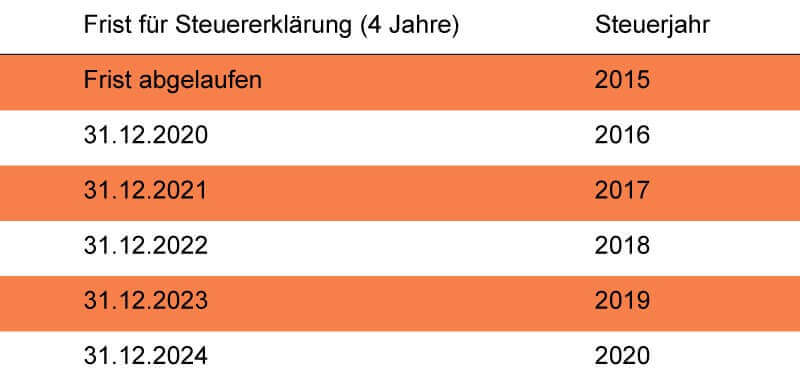 This table clearly illustrates how long tax returns can actually still be filed retroactively. A relatively long time has passed since 2016, and yet filing a tax return would still be possible until the end of this year.
Tax Returns by Experts in Düsseldorf and Oberhausen
As tax advisors, retroactive tax returns also help us with many clients. Especially with new clients who present their financial circumstances to us, it often happens that tax-relevant items come to light that existed in previous years but were not reported in a tax return. If such items are uncovered during an initial consultation, we can act quickly to prepare a retroactive tax return for you and potentially secure a refund plus interest from the tax office.
Do you have questions about this topic or need assistance with a tax matter? Our team is happy to help you with all tax-related issues. With our offices in Düsseldorf and Oberhausen, we offer you direct points of contact. Contact us to schedule a consultation. We look forward to meeting you.

