

Getting married is a very special occasion for many couples. In Germany, marriage holds great social significance, so it is hardly surprising that the majority of Germans are married. In 2018, 449,000 marriages were performed in Germany—and the trend continues to rise. Getting married also has certain tax implications and aspects that you should be aware of. So if you’re planning a wedding, it’s advisable to consider and plan for your tax situation as well. In this article, we have summarized the most important tax implications of marriage so that you can enter into your partnership well-prepared. As tax advisors in Düsseldorf
and Oberhausen,
we have summarized the information in detail but in an easy-to-understand manner.
Tax Basics for Marriages
All tax regulations are based on the civil law institution of marriage. Accordingly, the tax aspects generally apply only to civil marriages. Alternative partnerships, such as common-law marriages or households sharing expenses, are therefore not subject to the special tax regulations. Couples who were married only in a church ceremony are also not affected by these special provisions. Registered civil partnerships, however, are treated the same as civil marriages for tax purposes. If a marriage is legally validly concluded abroad, it is generally recognized as such in Germany as well.
Note: Only an intact marriage is recognized for tax purposes. This requires a physical, personal, and emotional union between the spouses.
If a legally valid marriage has been entered into, there are various tax areas that may be affected by changes. We will explain the most important aspects below.
Choosing the Tax Assessment Method
An important basis for the taxation of married couples is the form of assessment. If the spouses do not apply for separate assessment, they are automatically assessed jointly. Such joint assessment often makes sense due to the splitting benefit. In most cases, joint assessment is at least not disadvantageous. Applying for separate assessment is only advisable in specific cases. It is therefore advisable to consult a tax advisor in case of doubt to determine whether there are any specific advantages. However, most married couples are well advised to stick with the standard joint assessment. The assessment method can be changed once a year and is therefore not a final decision.
Overview of Income Tax Brackets
When it comes to marriage and taxes, many people immediately think of income tax brackets. The goal is to choose the optimal tax bracket to maximize income tax benefits. In reality, however, the choice of income tax bracket has only a minor impact on taxes. It affects only the income tax withholding during the year. Once a tax return is filed, the final taxation takes place. This balances out any potential advantages and disadvantages of the tax bracket. Generally speaking, however, a combination of III/V is worthwhile for couples with significant differences in income. If incomes are roughly the same, the IV/IV combination is advisable. To get the best outcome for your individual situation, it makes sense to consult a tax advisor.
Note: The choice of income tax bracket may have non-tax implications. For example, various social benefits (e.g., parental allowance) are often tied to net income. The choice of income tax bracket should therefore not be considered solely from a tax perspective.
The Benefits of Spousal Tax Splitting
One of the most important tax aspects of marriage is the splitting benefit. This benefit applies only to couples who have opted for joint taxation. The splitting benefit arises when the spouses’ incomes are added together to determine the tax liability and then divided in half. This can result in a tax benefit ranging from €0 to a maximum of €16,000. The specific amount of the benefit is influenced by the difference in the spouses’ incomes. For example, the following splitting benefits may arise:
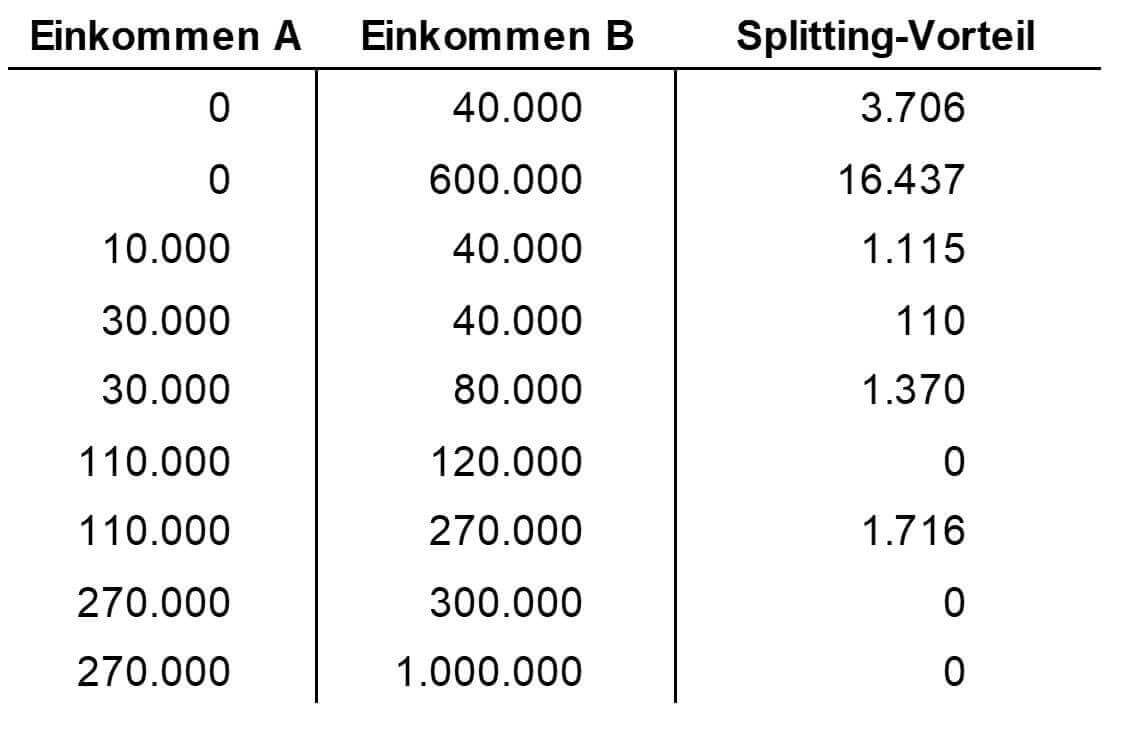 Depending on the distribution of income, it may therefore be worthwhile to consider spousal splitting. Here, too, consulting a tax advisor is advisable and appropriate to avoid mistakes.
Adjustment of the saver’s allowance and pension contributions
For married couples, the saver’s allowance doubles to a total of €1,602. This amount can be freely allocated between the spouses. This means a tax advantage may arise if only one spouse has income or if there is a significant difference in income. Additionally, a joint maximum amount for deductible pension contributions is established.
Impact on sales tax
If one of the spouses is self-employed, sales tax may become relevant. It is important to ensure that the other spouse is not unintentionally included in the sales tax liability. If both spouses are mistakenly considered joint business owners, this can lead to tax issues. Liability issues and risks related to input tax are often the result. Accordingly, it is important for business owners to seek detailed assistance from a tax advisor before getting married. As a tax consulting firm in Düsseldorf and Oberhausen, we are happy to assist business owners with tax-related questions.
Impact on Inheritance Tax
Inheritance tax is also affected by marriage. Spouses receive significant tax benefits regarding inheritance tax. There is a significantly higher tax exemption, and special tax exemptions are also granted. For example, there are special rules for spouses regarding the transfer of the family home. The extensive exemption from real estate transfer tax is also advantageous in the case of a transfer between spouses.
Church tax and second-home tax after marriage
In the case of a marriage between spouses of different faiths, church tax is assessed individually even in the case of joint taxation. The spouses are treated separately for tax purposes.
As soon as one of the spouses maintains a second home for professional reasons, it is exempt from the second-home tax. No such provision exists for unmarried couples!
What about criminal tax proceedings involving spouses?
In the context of criminal proceedings for tax offenses, married couples have the right to refuse to testify. Accordingly, a spouse is not required to comment on their partner’s tax matters. This rule applies even in cases of joint assessment or knowledge of conduct subject to criminal tax law.
Are there any tax disadvantages to getting married?
Getting married does not always come with tax advantages. Fortunately, however, tax disadvantages are also very rare. One exception would be, for example, the loss of the tax credit for single parents. Beyond that, no disadvantages are generally to be expected. During a consultation, only the advantages can be identified, which are likely to further enhance the joy of getting married.
What happens after the marriage ends?
If a marriage ends in divorce, tax consequences must also be considered. Income tax benefits—such as the splitting benefit—are lost no later than the year following the divorce. Especially in the case of divorce, tax consequences arise from the civil-law settlement. It therefore makes sense to consider this issue early on to avoid problems. Especially in cases of significant income disparities, precautions should be taken early on.
Help with tax questions and issues
Do you need help with tax questions or have a problem that is causing you concern? As tax advisors based in Düsseldorf and Oberhausen, we are happy to help you find customized solutions. With our high level of expertise and industry specialization, our team is the perfect partner, especially for business owners. Simply contact us to schedule a consultation.

