

Real estate and land are on everyone’s lips as attractive investments. Many people share the dream of owning their own home. And when people buy, they also sell. In the current market, many owners are taking advantage of high prices to sell their properties at a profit. As is often the case, however, when selling a property, you can’t just celebrate the profit—you also need to consider tax implications. Trading in real estate can unintentionally lead to tax disadvantages if you do not inform yourself sufficiently. Likewise, high tax payments can be avoided if you follow basic recommendations. In this article, we will explain which taxes may apply when selling a property and how best to avoid them.
Tax Burden for Buyers and Sellers
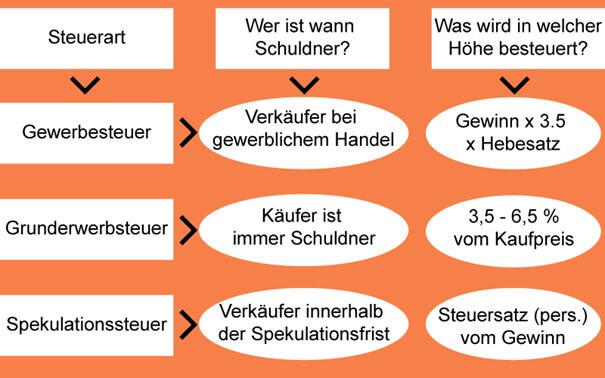
When a property is sold, there is a buyer and a seller. The taxes you must pay depend heavily on which side you are on. In this article, we will address the tax issues involved in selling a property. Nevertheless, it should be noted that when purchasing a property, tax obligations apply to the new owner. The buyer must always pay the so-called real estate transfer tax, which amounts to 3.5–6.5% of the purchase price. If the purchase is a commercial transaction, value-added tax may also be due under certain circumstances. Below, we focus on the tax implications for sellers.
Selling Real Estate Privately – When Do You Have to Pay Taxes?
Surprisingly, it turns out that the seller of a property can avoid a tax burden relatively easily. First, it’s important to note that you only have to pay taxes if a net profit was realized from the sale. And even that profit isn’t necessarily subject to tax. For all private real estate sales, the sale remains tax-free after a period of 10 years. This 10-year period means that the property must have been in your possession for that duration. If an apartment, house, or plot of land is sold within this timeframe, the so-called capital gains tax must be paid. The amount of the tax depends on your personal tax rate. Given that a real estate purchase is generally a long-term investment and that the majority of property owners easily meet this “holding period” anyway, the capital gains tax is rarely incurred. According to Section 23 of the German Income Tax Act (EStG), the sale of a property after 10 years is therefore completely tax-free!
However, German tax law provides for another scenario in which a tax-free sale is possible even for properties held for less than 10 years. Profits from the sale of a private residence are always tax-free if the apartment or house was used for personal residence. The property can be sold tax-free if you used the property exclusively for private purposes in the year of sale as well as the two preceding years. It is not mandatory for the owner to have lived in the apartment or house. It is also considered personal use if children (eligible for child tax credit) or a spouse or partner have lived in the property.
Taxable Real Estate Sale – How Can You Still Save on Taxes?
If the aforementioned aspects do not apply to your situation, you may be required to pay taxes on the sale. It is important to note that the capital gains tax does not simply have to be paid in full. Tax law always adheres to the objective net principle. Accordingly, the taxpayer should only pay taxes on the actual profit. As with other types of taxes, expenses related to the real estate sale can be claimed on the tax return to reduce the tax burden. The following expenses are deductible:
- Brokerage fee
- Notary fees
- Early repayment penalty
- Land registry entry
- Costs for preparing a valuation report
- Advertising costs related to the property
- Repair and modernization costs may be deductible under certain conditions. It should be noted that the expenses must have been incurred within the first three years after the purchase of the property. Additionally, the expenses (excluding sales tax) must exceed at least 15% of the acquisition costs (so-called acquisition-related production costs).
Since the aforementioned expenses often involve significant costs and occur in many sales, most sellers can save a substantial amount in taxes. You should consult a tax advisor to determine which expenses you may claim in your specific case. This will help you avoid overlooking essential expenses or making other mistakes.
The Commercial Sale of Real Estate
So far, we have focused exclusively on private sales transactions. But what about the commercial sale of real estate? Property owners who may own multiple properties and buy/sell at a higher frequency may be classified by the tax office as commercial sellers. If three or more properties are sold within five years with the intent to make a profit, the tax office will assume a commercial activity. This can quickly lead to problems, especially for sellers who own multiple properties and trade in them but do not actually intend to engage in a commercial activity. If the tax office determines that commercial trading is taking place, all profits must be taxed as commercial income under Section 15 of the Income Tax Act (EStG). For you as a real estate seller, this means that trade tax becomes due. The seller must pay trade tax in the case of commercial real estate transactions. Therefore, you should avoid slipping into the commercial sector whenever possible. Careful planning of real estate sales can prevent you from being caught off guard by the tax office at some point.
Inherited and Selling Real Estate – What Tax Considerations Apply?
If you have inherited a property, you may wish to sell it. When selling such a property, you must consider the factors we explained regarding private sales. When determining whether taxes must be paid, it is therefore important to consider how long the property was owned and how the house or apartment was used. In the case of an inheritance, it is important to note that not only the property but also the capital gains tax holding period is inherited. You, as the heir, therefore assume and continue these periods. If the decedent had owned the property for more than 10 years, you do not have to pay taxes even in the case of a direct sale.
Overview – Taxes on a Real Estate Sale
Finally, we would like to provide a clear overview of the taxes mentioned in connection with a real estate sale. The following table lists all relevant taxes with the corresponding details.
Questions for a tax advisor
We hope this article has helped you understand the tax considerations involved in selling real estate. If you are planning to sell a property, we wish you every success with the transaction. When it comes to tax matters, it is always advisable to consult a qualified tax advisor. A tax professional can also assist you in completing all procedures quickly and efficiently regarding today’s topic. During an initial consultation, you can see our expertise for yourself and ask any questions you may have. Please feel free to contact us. We look forward to welcoming you at one of our offices in Düsseldorf or Oberhausen.

