
When filing a tax return, the taxpayer’s goal is always to keep the tax burden as low as possible. In addition to the well-known deductible income-related expenses, there are other options that can significantly reduce your tax burden. These include flat-rate allowances and tax credits. In both cases, taxable income can be reduced, which ultimately lowers the tax burden. In some cases, the flat-rate allowances and tax credits are automatically applied to your tax. In other cases, however, you must apply for these benefits. To give you an overview of all tax credits, we have summarized and briefly explained all possible flat-rate allowances and tax credits in this article.
Tax Deductions – What Is the Difference Between a Flat-Rate Deduction and a Tax Exemption?
Flat-rate allowances and tax credits are grouped under the umbrella term “tax credits.” We often see taxpayers confusing the two categories or failing to distinguish between them. Although flat-rate allowances and tax-free allowances are often lumped together, there is a significant difference in their tax implications.
An allowance is a certain portion of income that is tax-free. Taxes are only levied on the income exceeding the respective allowance. There are various allowances that effectively reduce taxable income.
The flat-rate allowance, on the other hand, works differently. A flat-rate allowance is a specific amount that can be claimed on the tax return as a lump sum, meaning without having to provide receipts. The total of the respective flat-rate deduction can be claimed even if the actual expenses were lower. If the actual costs exceed the flat-rate deduction, the total costs can be claimed. However, a receipt is required for this. In this case, the flat-rate deduction becomes irrelevant.
What tax deductions are available?

To give you an overview of the available tax allowances, we have compiled a detailed list below. Following a tabular list, all tax allowances are briefly explained. This allows you to quickly identify which tax allowances you may be eligible for.
1. Basic Exemption
The basic exemption is arguably the most important and fundamental exemption in German tax law. The basic exemption applies to income derived from employment. The basic exemption of 9,408 euros (2020) remains tax-free. The basic allowance is particularly essential in the context of part-time employment, as this amount is often not exceeded or only barely exceeded. Income remains tax-free until the basic allowance is reached.
2. Child Allowance
As the term suggests, the child allowance provides relief for families with children. It should be noted, however, that the child allowance only applies if the resulting tax savings exceed the child benefit. Only the child allowance is granted or child benefit is paid. The tax office determines and implements the option that is more favorable for the taxpayer. Families receiving the child allowance can benefit from an allowance of 7,428 euros (2020). The child tax credit consists of the child’s care, upbringing, and education needs (€2,640) and the child’s subsistence minimum (€4,788).
3. Education Allowance
The education allowance can be viewed as an additional allowance for parents. The allowance of 924 euros is granted only if the children are of legal age, no longer live at home, and are currently pursuing vocational training. Additionally, it is important that the parents are eligible for child benefit. If these requirements are met, the education allowance can be applied.
4. Instructor Allowance
Taxpayers who, in addition to their professional work, also serve as instructors, lecturers, educators, or artists can benefit from the instructor tax exemption. The exemption is granted only if the activity is performed for a nonprofit or public-law entity. Typical examples include work with the volunteer fire department or in recreational sports. Under the instructor tax exemption, expense reimbursements and income up to 2,400 euros remain tax-free.
5. Tax Relief for Single Parents
Generally, it must be assumed that single parents face a greater financial burden. To offset this additional burden, the tax office grants a relief amount of 1,908 euros. If there are multiple children in the household, an additional 240 euros is added for each additional child. If you are in tax bracket II, the relief amount is automatically applied. Single parents in a different tax bracket must submit an application to receive the allowance.
6. Volunteer Tax Credit
Taxpayers who perform volunteer work can apply for an allowance of 720 euros. Please note that the volunteer allowance can only be claimed in conjunction with a tax return. If you do not wish to file a tax return, you cannot benefit from this allowance.
7. Pension Allowance
As a recipient of pension benefits, you can receive a pension allowance plus a supplement. Only the portion that exceeds the allowance is subject to taxation. To claim the allowance, the pension benefits must be reported on your tax return. The amount of the pension allowance depends on when the payments began. Under German tax law, the pension allowance is a phase-out provision that will be gradually phased out by 2040.
8. Senior Citizen Tax Relief
Taxpayers who are already retired and were born before 1975 are entitled to the senior relief amount. The amount of the relief depends on the date of birth. The allowance is automatically calculated and applied by the tax office. Similar to the pension allowance, the senior relief amount is also a phased-out provision that will be gradually discontinued by 2040.
What are the flat-rate allowances?
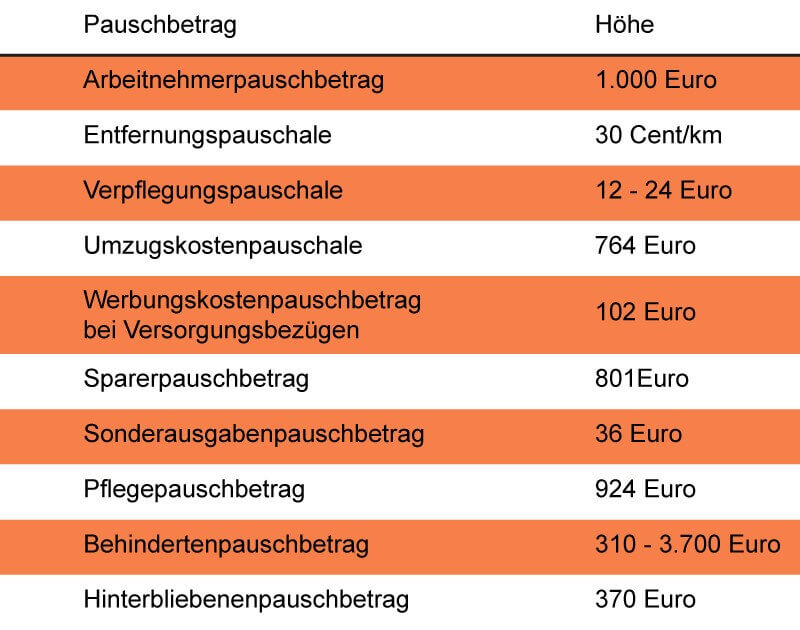
Now that you have an overview of all the allowances, we would like to turn our attention to the flat-rate allowances. To provide a clear overview, we have summarized all the flat-rate allowances in a table below and explained them in detail. This will allow you to quickly identify which flat-rate allowances apply to you.
1. Employee Flat Rate
The best-known flat-rate allowance for employees is the employee flat-rate allowance, also known as the income-related expenses allowance. The flat-rate allowance of 1,000 euros is automatically included in the calculation by the tax office. If your actual income-related expenses exceed the flat-rate allowance, you can claim them on your tax return with the appropriate documentation.
2. Commuting allowance
The commuting allowance allows you to claim a flat rate for the costs incurred while commuting to work. You can claim 30 cents per kilometer on your tax return. However, only the “most direct” route applies. So, taking a long detour to save on taxes won’t work.
3. Meal allowance
Taxpayers who are traveling for business can deduct various expenses. This includes a flat rate for meals during a business trip. As soon as the business trip lasts longer than 8 hours, a flat rate of 12 euros per day can be claimed. If the business trip lasts longer than 24 hours, 24 euros per day is allowed. For the days of arrival and departure, 12 euros can also be claimed. If the actual costs are higher, you cannot claim them on your tax return. A receipt won’t help in this case either.
4. Moving Expense Allowance
Sometimes it is necessary to move for professional reasons. Taxpayers who move for professional reasons can slightly reduce their tax burden with the help of the moving expense allowance. Single individuals may claim 764 euros. Married couples, on the other hand, may claim 1,528 euros. No receipts are required to claim the allowance. However, if higher costs were incurred, these may be claimed for tax purposes with the appropriate receipt.
5. Flat-Rate Deduction for Income-Related Expenses for Pensioners
Taxpayers who receive pension benefits are eligible for an additional flat-rate allowance for income-related expenses of 102 euros. Pension benefits may include widow’s and orphan’s benefits, a pension, or alimony. The additional lump-sum allowance is added to the general employee lump-sum allowance. This directly reduces taxable income and lowers the tax burden.
6. Savings allowance
If you earn a return on investments or stock transactions, you must pay taxes on this income. With the saver’s allowance or exemption order, up to 801 euros can remain tax-free. The exemption order must be filed with the tax office to receive the lump-sum allowance for capital assets.
7. Special Expense Allowance
Special expenses can be claimed on your tax return with the appropriate documentation and can reduce your tax burden. If you do not provide any information regarding special expenses, the tax office will apply a flat-rate amount of 36 euros. This happens automatically and without any action on your part.
8. Flat-Rate Care Allowance
Taxpayers who provide home care for relatives are entitled to the flat-rate care allowance. The flat-rate care allowance is granted only if the person receiving care is helpless or meets care level 4 or 5. The lump-sum allowance of 924 euros must be claimed on your tax return. In special cases where multiple people provide care, the care allowance is also divided among them.
9. Disability Allowance
People with a disability can benefit from the disability allowance. The amount of the allowance depends on the degree of disability. It can range from 310 to 3,700 euros. The lump-sum allowance must be claimed on the tax return. If actual costs were higher, these can be claimed as extraordinary expenses. If this option is chosen, the lump-sum allowance no longer applies.
10. Survivor’s Flat-Rate Allowance
If you receive survivor benefits as a widow, widower, or orphan, a lump-sum allowance may be claimed. The so-called survivor’s lump-sum allowance is set at 370 euros per year.
Questions for a tax advisor
We hope you found this article helpful and that you now have a better understanding of which tax allowances may apply to your specific situation. For further details and questions on this topic, you should consult a qualified tax advisor. As your tax advisor in Düsseldorf and Oberhausen, we are the ideal point of contact for tax-related matters. With years of experience, our team can assist you with all tax matters and develop the best possible solution for you. Contact us to schedule a consultation.

